https://vimeo.com/522452949 Amid all the dents and formulaic verbiage that makes up the text of China’s 14th Five-Year Plan, is one particular piece of text that has largely passed observers and commentators by. And it reads like this: ‘’China will promote the establishment of a global Internet governance system that is multilateral, democratic and transparent’’. On the face of it nothing could be more innocuous. But that would be a major misreading of a very important piece of text. And the key to this, is the term multilateral. Currently global Internet governance operates under the multi-stakeholder system. In this system a wide variety of stakeholders get to determine how it works. But China wants to replace this very democratic and informal system with what it calls a multilateral system. In it national governments would determine how the Internet works. In effect China’s multilateral system would be a formula for an Internet…
How China’s Stock Market Differs to the US – 3 Key Pointers
Enodo Economics Chief Economist, Diana Choyleva with her thought of the day. https://vimeo.com/521477532 With Chinese equities correcting sharply after a formidable post-Covid surge, I thought I’d discuss today three important ways in which trading on the A-share market differs from the US market. First, in China there is no day trading. If you buy a stock on Monday, you can’t sell it until Tuesday. All positions must be held overnight. In this context China’s recent trading numbers are impressive. Second, all markets are fully funded. If you want to buy 100 RMB worth of shares you need to have a 100 RMB in your account, before you can do so. The positive flipside of that, is that settlement is almost guaranteed. Third, there is a limit up and limit down – both are 10% but for ChiNext and the STAR board they are 20%. So, you can’t have crazy intraday…
Beijing Wants Reset of US China Relations; DC Dislikes the Terms
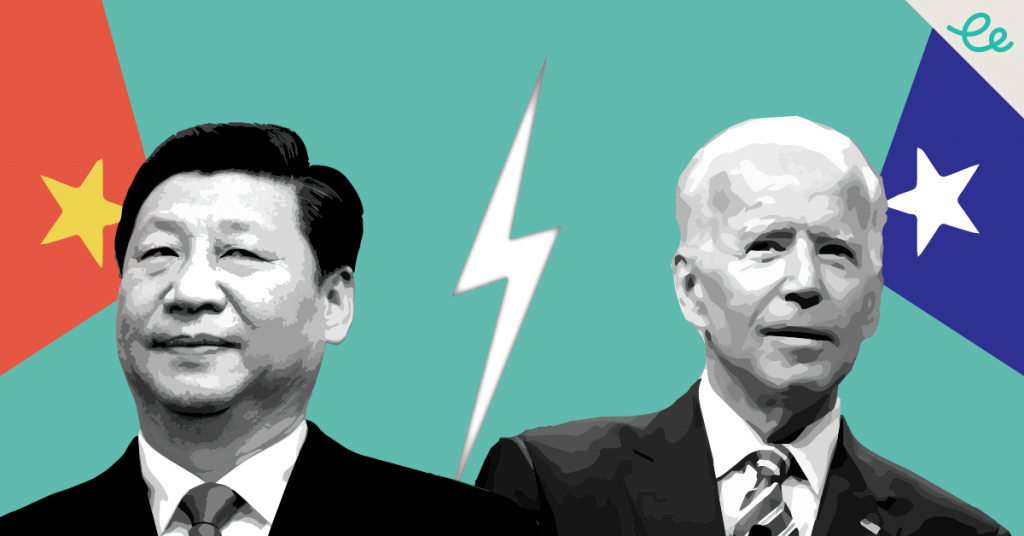
During his first full month in charge, Joe Biden showed his Chinese counterpart that the 46th US President may prove less confrontational than the 45th, but the White House’s tough approach to Beijing and US China relations looks set to stay. This article is a summary of important US China news in February 2021. After the turmoil of the Donald Trump years, and the trade war that defined the world’s key bilateral relationship, Xi Jinping hoped for a return to calmer times. Senior diplomat Wang Yi called for a reset in relations, if US policymakers “abandon biases” and “give up unwarranted suspicions”. China’s top diplomat, Yang Jiechi, warned the US not to interfere in Hong Kong and Xinjiang, and placed the blame for the deterioration in relations squarely on the US. Washington accused Beijing of trying to avert blame for its actions. On trade, Katherine Tai, Biden’s USTR pick, backed…
Biden’s China Policy and Team
What to watch out for if China and the US are to avoid a Thucydides Trap. https://vimeo.com/511605525 Joe Biden and Xi Jinping finally spoke. If you were hoping for a thawing in US China relations, you will be disappointed. Days before the call Biden described America’s China policy as ‘’extreme competition’’. Enodo Economics just published our deep dive into Biden’s China policy and his team. And our overall conclusion is that this is a hawkish team, but one which is experienced and competent. Now both countries acknowledge that they must cooperate on certain issues, in particular the most important one – being climate change. So I’ll argue that if you are looking for a bellwether on whether China and the US can coexist peacefully and avoid ultimately, each one trying to overpower the other, the thing to watch is the negotiations on climate change. And of course, Biden’s key climate…