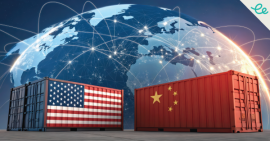
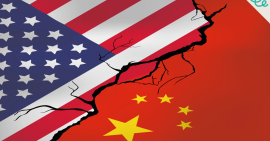
Trump and Xi meet in Washington in late September. The cameras will be on the tariffs. The AI on the table matters more, and the race beneath it has been misread.
Unlock Critical Insights
Gain exclusive access to Enodo’s analysis and expert network, and understand how this issue will reshape your world. Register for Trial Access to our premium research — or book Diana as a speaker for your next event.


When Donald Trump and Xi Jinping meet in Washington in late September, most of the room will be watching the wrong thing.
The coverage will fix on tariffs, soybeans and Boeing orders, and on whether the handshake reads as thaw or rupture. What counts sits underneath. At this meeting, one of the consequential questions will sit well below the trade headlines: whether the two governments can agree any guardrails around AI’s most dangerous uses. That, far more than the trade theatre, will tell you whether the détente amounts to anything.
The guardrails matter. Washington and Beijing talked about AI risk under Biden, but the dialogue produced little beyond dialogue. If Trump and Xi can now agree even a limited mechanism for managing the most dangerous uses of AI, it would be a meaningful sign that the two governments can still cooperate where their interests genuinely overlap.
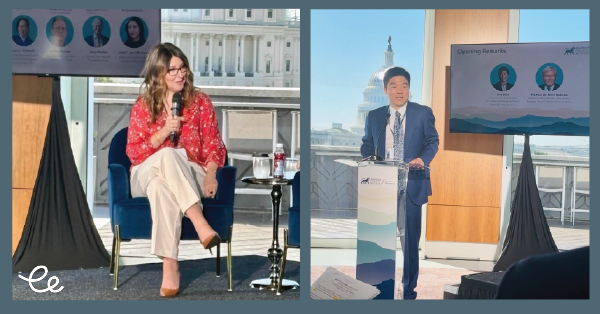
My discussions at the inaugural Washington China Dialogues on 2 June, organised by the Asia Society Policy Institute’s Center for China Analysis, suggested that AI guardrails are a key focus for the Trump administration, and for Treasury Secretary Scott Bessent in particular.
But don’t mistake cooperation on risk for any easing of the competition underneath it. Neither side is about to let up in the struggle for technological advantage.
And the key to understanding that struggle is something neither delegation will say plainly: Washington and Beijing are not running the same AI race.
America is chasing the summit. Its bet is that the biggest, cleverest model, trained on the most advanced chips in existence, eventually gets you something near general intelligence. That chase runs on frontier hardware, which is why denying China the hardware looks, from Washington, like a way to win.
China is climbing the mountain too. But it is placing a much bigger bet on what happens below the summit. Cut off from the best hardware, it has leaned into diffusion instead: spreading good-enough AI through factories, logistics and clinics so that a thousand small improvements accumulate into an industrial edge. Washington is betting on a breakthrough; Beijing is betting that enough incremental gains, widely deployed, add up to more. Markets are pricing the two as one trade. They are not the same trade at all.
You can read the strategy off what China ships. While the leading American labs keep their best systems behind closed weights, Chinese developers have made open weights a central competitive weapon. Moonshot AI’s Kimi K3, Alibaba’s new Qwen3.8-Max and its rivals are open-weight models, released with the weights attached so any factory, ministry or start-up can download them, adapt them and run them in-house.
Open-weight against closed-weight is not a licensing footnote but a distribution strategy, and it has fed an AI price war that keeps dragging the cost of a capable model ever lower.
Cheap, open and everywhere is how you close the US-China AI gap in deployment without ever winning the race for the single cleverest model. Distillation has helped Chinese labs narrow the frontier gap too, faster than the export controls assumed.
Export controls were meant to keep China off the summit. They do far less to stop it working the slopes below, and that is where it has begun to build: one tier under the frontier, in the band its diffusion strategy depends on.
In late July, a state-backed firm in Shanghai was reported to have begun making China’s first home-grown immersion deep-ultraviolet lithography machines. These are not the extreme-ultraviolet systems only ASML can build and China is banned from buying; they are the workhorse tools capable of producing much of the chip base on which mass AI diffusion depends. China’s DUV machines are unproven and may not yet yield at commercial scale. But they start to answer the question that could have sunk the whole thesis: could China keep diffusing AI if Washington denied it not just advanced chips but the means to make substitutes at home?
The market heard about the machine in July. Our clients heard about it in June.
At a closed-door Enodo Consilium, under the Chatham House Rule, a participant with deep expertise in semiconductor manufacturing equipment told the room he had seen a domestically produced Chinese immersion-DUV machine with his own eyes. His expertise meant he was well placed to identify exactly what he was looking at. The public reporting since suggests the signal was real.

It was not the only warning from those sessions. In our June Consilium, guest speaker Simon Thomas, whose firm, Paragraf, was the first in the world to mass-produce graphene-based electronic devices using standard semiconductor processes, made a related, and more awkward, point. Western industrial policy, from the CHIPS Act to Europe’s subsidies, is largely aimed at rebuilding yesterday’s capability, he argued, while export controls risk blinding us to what China is building next. Break the commercial links and you lose your view. Denied the kit, China makes its own, and outsiders lose the ability to watch it happen.
When Paragraf started out, Simon reckoned it was seven or eight years ahead of the world in graphene. Since opening a subsidiary in China, he now puts Chinese firms just a couple of years behind.
The gap in tomorrow’s materials and technology is closing while we busy ourselves securing yesterday’s supply chains.
This is the backdrop to September. On the most dangerous AI capabilities the two sides do share an interest: both have reason to keep the worst tools away from non-state actors. But the guardrails sit on top of a rivalry neither will concede – the hard core of the tech decoupling this whole détente is meant to manage.
America leads at the frontier and China has made diffusion a strategic priority, and neither will put its name to anything that freezes in the other’s advantage. Both sides fear where unchecked AI risk leads, and both know any binding rule would lock in someone’s lead. So the test is simple. Does the meeting produce a mechanism that works, or a photograph? The answer will tell you more about how long this calm lasts than any communiqué, and much more than the tariff headlines that will run alongside it.
None of this is purely industrial. In July, around the World Artificial Intelligence Conference in Shanghai, China formally launched the World AI Cooperation Organisation, WAICO, headquartered in Shanghai and pitched squarely at the Global South, with twenty-nine founding members and not one major Western democracy among them. In his keynote the following day, Xi Jinping made open-source AI the centrepiece, cast artificial intelligence as a global public good, and offered thousands of training places for developing countries.
Set against the humanoid robots crowding the WAIC floor, it is the diplomatic face of the same diffusion strategy: cheap Chinese AI, Chinese standards and Chinese hardware, spreading through the economies the West has been slower to court.
This is what AI bifurcation looks like in practice – not one internet splitting in two, but two technology orders forming around two different bets.
Technology ecosystems do not stop at AI. The same disruption has reached the plumbing of global finance. Distributed-ledger technologies – blockchain among them – are starting to reshape the rails over which cross-border payments settle, and China has moved faster than the West to embed them in new cross-border payment infrastructure, building out a yuan-based financial architecture beyond its borders.
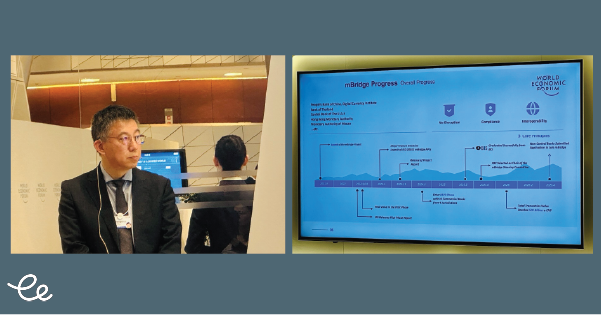
At the Summer Davos in Dalian, I listened to Mu Changchun, director-general of the Digital Currency Institute at the People’s Bank of China, update the audience on mBridge and China’s evolving cross-border payment infrastructure. I have spent much of the summer digging further into that story for our forthcoming book, “Hong Kong’s Financial Evolution: China’s Bid to Shape Global Capital Flows”, the third in our trilogy on China’s efforts to internationalise the yuan, following “China’s Quest for Financial Self-Reliance: How Beijing Plans to Decouple from the Dollar-Based Global Trading and Financial System” (2022) and “Petrodollar to Digital Yuan: China, the Gulf, and the 21st Century Path to De-Dollarization” (2025).
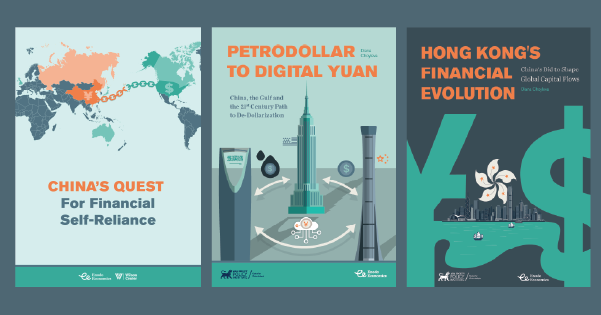
The more you look at it, the harder it is to separate the technology contest from the monetary one. China is not simply trying to export AI, chips or standards. It is also building the infrastructure through which trade and capital can increasingly move on Chinese-designed rails.
That does not amount to the end of the dollar. But it does create more places in which the yuan, Chinese payment systems and Chinese financial infrastructure can become useful. And that is where the technology race begins to intersect with the fight over the dollar.
How serious that challenge to the dollar really is, and how far the yuan has come, is the subject of our next Enodo Consilium on 15 September. My guest is Barry Eichengreen, one of the great historians of international money. Alongside Janet Yellen, Sir Mervyn King, Rafael Reif, Orit Gadiesh, and other experts we will test whether the dollar’s dominance is genuinely being contested and how far China has progressed in building an alternative.
Again and again, the decisive move sits a tier below the headline – in AI diffusion rather than the frontier model, in the plumbing rather than the reserve currency status. Keep your eyes fixed on the summit and you will miss what is being assembled on the slopes below.
If that is the only race you are watching, you have a blind spot.
Enodo exists to find these shifts before they become consensus. If that is the edge you need, try our research or join us at the next Consilium.
Get the Enodo Edge